
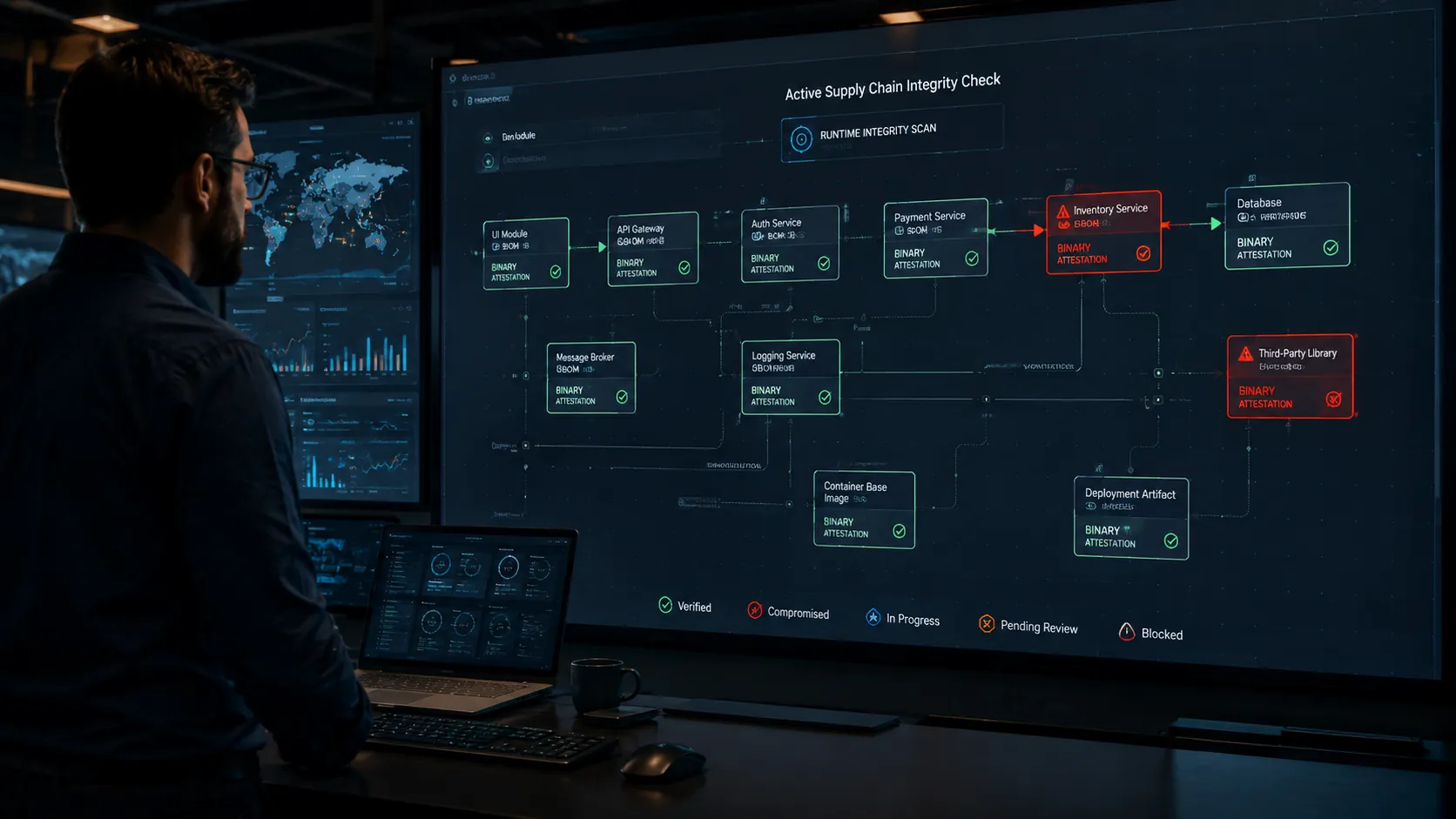
Software supply chain security means verifying the integrity, provenance, and safety of every component in your software stack — from open-source libraries to container images to CI/CD pipelines. Vendor questionnaires ask vendors to self-report security posture. Technical controls verify it independently through SBOMs, cryptographic attestation, and continuous monitoring.
What Is Software Supply Chain Security?
Modern software is assembled, not written. A typical enterprise application contains 70-90% open-source and third-party components. Supply chain security ensures every component — library, framework, container base image, CI/CD tool — is authentic, uncompromised, and free of known vulnerabilities. The attack surface includes dependency confusion, typosquatting, compromised maintainer accounts, malicious commits, and build pipeline injection.
Why Vendor Questionnaires Are Insufficient
A vendor questionnaire asks: "Do you have a vulnerability management program?" The vendor answers yes. SolarWinds had a vulnerability management program. Codecov had a vendor questionnaire. Both were compromised. Questionnaires measure intent, not reality. Technical controls measure actual security posture through verifiable evidence.
Key Challenges
Dependency Depth
Your direct dependencies have dependencies. A single npm package may pull in 500+ transitive dependencies. Vulnerability in a deeply nested transitive dependency can affect your entire application. Manual review is impossible at this depth.
Provenance Verification
Knowing a package name and version is not enough. You need to verify that the binary you are running was actually built from the source code you expect, by the build system you trust, without tampering. This requires cryptographic attestation beyond standard code signing.
Runtime Drift
A clean build does not guarantee a clean runtime. Configuration changes, environment variable injection, dynamic loading, and sidecar containers can introduce compromise after build time. Runtime integrity monitoring closes this gap.
Recommended Resilience Framework
1. Software Bills of Materials (SBOMs)
Generate SBOMs for every build using SPDX or CycloneDX format. SBOMs list every component, version, license, and dependency relationship. Automate SBOM generation in your CI/CD pipeline. Store SBOMs in a central repository for vulnerability correlation and compliance reporting.
2. Binary Attestation and Provenance
Implement SLSA (Supply chain Levels for Software Artifacts) framework. Sign builds with Sigstore/Cosign for reproducible provenance. Use in-toto attestations to bind build materials (source commit, builder identity, build instructions) to the final artifact. Verify attestations before deployment.
3. Software Composition Analysis (SCA)
Deploy SCA tools (Snyk, Dependabot, OWASP Dependency-Check) in CI/CD pipelines. Block builds with critical or high-severity vulnerabilities. Enforce license compliance policies. Monitor for newly disclosed vulnerabilities in deployed dependencies.
4. Runtime Integrity Monitoring
Use file integrity monitoring (AIDE, Tripwire, OSSEC) on production systems. Deploy container image signing and admission controllers (Kyverno, OPA Gatekeeper) that reject unsigned or tampered images. Monitor for unexpected process execution, library injection, and configuration drift.
5. Incident Response for Supply Chain Compromise
Define playbooks specific to supply chain incidents: identify affected components via SBOM, assess blast radius, roll back to known-good versions, notify downstream consumers, and coordinate with upstream maintainers. Practice supply chain incident response quarterly.
| Control Layer | Vendor Questionnaire Approach | Technical Verification Approach |
|---|---|---|
| Evidence Type | Self-reported claims | Cryptographic proof |
| Verification Timing | Annual or ad-hoc | Continuous, per-build |
| Dependency Visibility | Surface-level | Full transitive SBOM |
| Provenance | Trust vendor statement | Signed attestations (SLSA/Sigstore) |
| Runtime Assurance | None | Integrity monitoring + admission control |
| Incident Response | Vendor coordinates | Automated rollback + SBOM-guided triage |
Trust-based vs. verification-based supply chain security
Practical Recommendations
- Generate SBOMs for every build and store them in a central, queryable repository.
- Implement SLSA Level 2+ build provenance with Sigstore/Cosign signing for all artifacts.
- Deploy SCA scanning in CI/CD with automated block on critical vulnerabilities.
- Enable container image signing and admission control in Kubernetes environments.
- Conduct quarterly supply chain incident response tabletop exercises.