
Disaster recovery (DR) is the structured process of restoring IT systems and data after a disruptive event — ransomware, hardware failure, natural disaster, or human error. It defines Recovery Time Objective (RTO: how fast to restore) and Recovery Point Objective (RPO: how much data loss is acceptable), then implements replication, failover, and validation to meet those targets.
What Is Disaster Recovery?
Disaster recovery is not backup. Backup creates copies of data. DR encompasses the entire lifecycle: detection, failover, validation, failback, and post-incident review. It answers: "When production fails, how do we resume operations within our business tolerance?"
Why DR Strategies Fail
Common failure modes: untested restores (backup exists but cannot be restored), RPO/RTO undefined (no business alignment), single-site replication (both production and DR in same flood zone), manual runbooks (dependent on specific people who may be unavailable).
Key Challenges
RTO/RPO Misalignment
Business units often demand RTO < 1 hour, RPO = 0 but fund solutions delivering RTO = 24 hours, RPO = 24 hours. The gap remains undiscovered until disaster strikes.
Ransomware Resilience
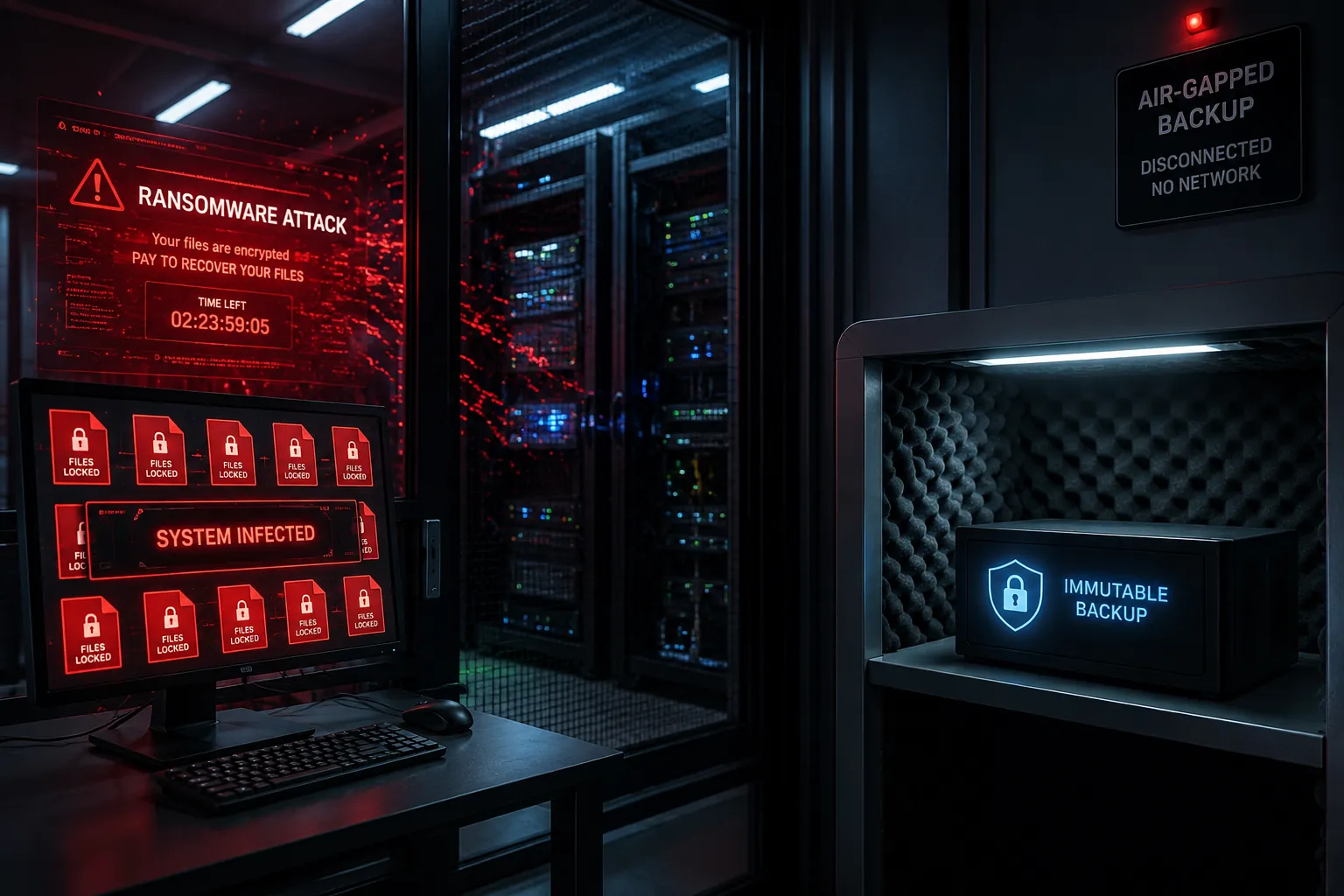
Modern ransomware encrypts or deletes backup repositories. Immutable, air-gapped, or offline copies are now mandatory — not optional.
Cloud DR Complexity
Cloud-to-cloud and on-premises-to-cloud DR introduce networking, identity, and licensing complexity. Failover testing in production cloud accounts risks production impact.
Recommended DR Architecture
Define Tiered RTO/RPO
| Tier | Systems | RTO | RPO | Approach |
|---|---|---|---|---|
| Tier 0 | Revenue-critical (ERP, trading, patient records) | < 15 min | Near-zero | Synchronous replication, automated failover |
| Tier 1 | Business-critical (CRM, email, collaboration) | < 1 hour | < 5 min | Async replication, orchestrated failover |
| Tier 2 | Operational (file shares, dev/test, analytics) | < 4 hours | < 1 hour | Scheduled replication, manual failover |
| Tier 3 | Non-critical (archives, cold storage) | < 24 hours | < 24 hours | Backup restore from immutable vault |
Immutable Backup & Air-Gapping
Use object storage with Object Lock (S3, Azure Immutable Blob) or purpose-built appliances (Veeam Hardened Repository, Rubrik). Maintain at least one copy offline or in a separate security domain.
Automated Failover Orchestration
Tools like Veeam DR Orchestrator, Zerto, Azure Site Recovery, AWS Elastic Disaster Recovery execute runbooks: network reconfiguration, DNS cutover, application health validation. Test quarterly.
Network & Identity Continuity
Pre-stage DR networking (IP ranges, DNS zones, VPN, firewall rules). Federate identity to DR environment. Test client access (VDI, VPN, SaaS) during drills.
Implementation Considerations
- Align DR investment with business impact analysis (BIA) — quantify revenue loss per hour of downtime per system.
- Automate everything that can be automated — human error increases under stress.
- Test in production-like conditions — isolated VLAN, production data subset, real client access.
- Document lessons learned — every test and real event updates runbooks.
| Capability | Basic Backup | Enterprise DR Strategy |
|---|---|---|
| Recovery Objective | Undefined | Tiered RTO/RPO per business impact |
| Replication | Nightly backup | Continuous (CDP) or frequent snapshots |
| Failover | Manual restore | Automated orchestration with validation |
| Ransomware Protection | Vulnerable | Immutable, air-gapped, offline copies |
| Testing Frequency | Annual (if any) | Quarterly automated, annual full |
| Network Readiness | Ad-hoc | Pre-staged DNS, VPN, firewall rules |
Basic backup vs. enterprise disaster recovery strategy
Practical Recommendations
- Conduct a Business Impact Analysis (BIA) to assign every system to a DR tier with executive sign-off.
- Deploy immutable backup storage (Object Lock, hardened repository) for all Tier 0-2 systems.
- Implement DR orchestration (Veeam, Zerto, ASR) with automated network and DNS failover.
- Schedule quarterly DR tests: tabletop (monthly), component (quarterly), full failover (annually).
- Include SaaS (M365, Salesforce, Google Workspace) in DR scope — they are not automatically protected.