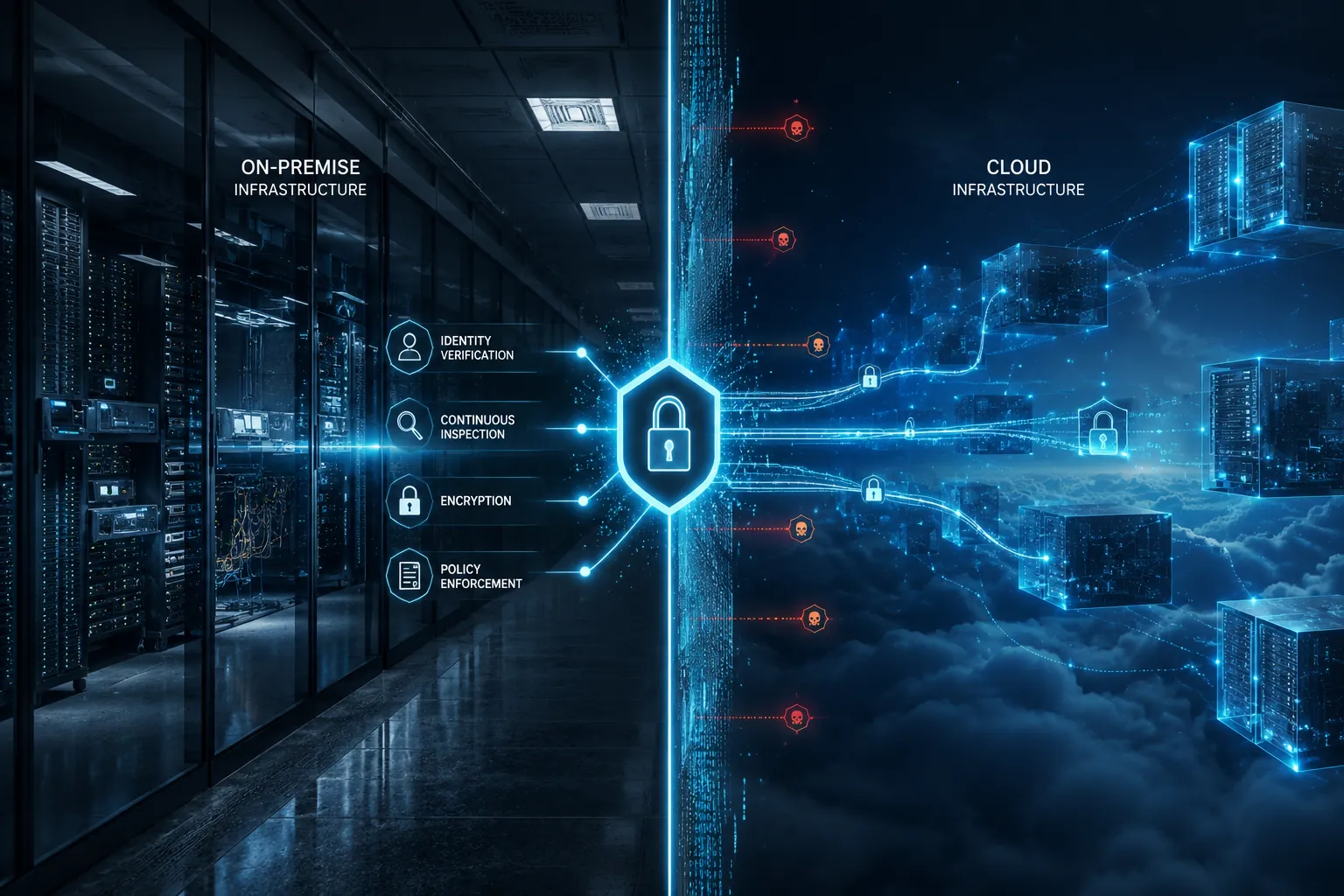

Modern workplace networking secures and connects a distributed workforce — office, home, coffee shop, airport — using identity-based Zero Trust Network Access (ZTNA), high-density Wi-Fi 6/7, application-aware SD-WAN, and centralized cloud management. It replaces the legacy castle-and-moat model with continuous verification and optimized paths to applications.
What Is Modern Workplace Networking?
Modern workplace networking is the architecture that connects users to applications regardless of location. It assumes no trusted network: every device, user, and flow is verified. It combines wireless (Wi-Fi 6/7), wide-area (SD-WAN), and access (ZTNA/SASE) into a single policy framework managed from the cloud.
Why Legacy Networks Fail
Traditional networks backhaul all traffic to the data center for inspection. Remote users VPN in, consuming bandwidth and latency. Branch offices rely on MPLS for reliability and broadband for cost — with manual failover. Wi-Fi 5 cannot handle density of video calls and IoT. Security is perimeter-based; once inside, lateral movement is unrestricted.
Key Challenges
Inconsistent User Experience
Office users get gigabit wired. Home users get consumer broadband with no QoS. Roaming users hop between cellular and public Wi-Fi. Application performance varies wildly.
Security Gaps
VPN grants broad network access. Compromised home router exposes corporate traffic. IoT devices on corporate Wi-Fi lack segmentation. Shadow IT bypasses controls.
Operational Complexity
Multiple vendors: Cisco for core, Aruba for Wi-Fi, Fortinet for firewall, separate SD-WAN appliance. Each has its own CLI, licensing, and support contract. Firmware updates are chaotic.
Recommended Architecture
Zero Trust Network Access (ZTNA)
Replace VPN with identity-aware proxy. Users authenticate to IdP (Entra ID, Okta), device posture checked (compliance, EDR status), then granted least-privilege access to specific applications — not network segments. No inbound ports exposed.
Wi-Fi 6/6E/7 for High Density
Deploy 802.11ax (Wi-Fi 6) or 802.11be (Wi-Fi 7) with OFDMA, MU-MIMO, and 6 GHz spectrum (Wi-Fi 6E/7). Design for 50+ clients per AP. Use WPA3-Enterprise with 802.1X. Segment IoT, guest, and corporate on separate VLANs with role-based firewall policies.
SD-WAN for Branch Optimization
Replace MPLS + broadband with application-aware SD-WAN. Dynamic path selection: latency-sensitive apps (Teams, Citrix) on best path; bulk traffic (backups, updates) on cheapest path. Integrated firewall, WAN optimization, and cloud on-ramp.
Unified Cloud Management
Single pane of glass for wired, wireless, WAN, and security. Configuration pushed via API/GitOps. AI-driven insights: coverage gaps, client health, application experience scores. Firmware compliance automated.
Implementation Roadmap
- Assess: Map user personas, application portfolio, current network topology, security gaps.
- Identity First: Deploy ZTNA for remote access. Deprecate VPN.
- Wireless Refresh: Site survey → Wi-Fi 6/7 design → phased deployment with validation.
- SD-WAN Rollout: Pilot at 3-5 branches → optimize policies → full deployment.
- Unify Operations: Migrate all devices to cloud controller. Enable AIOps insights.
| Capability | Legacy Network | Modern Workplace Network |
|---|---|---|
| Remote Access | VPN (network-level) | ZTNA (application-level) |
| Wi-Fi Standard | Wi-Fi 5 (802.11ac) | Wi-Fi 6/6E/7 (802.11ax/be) |
| Branch Connectivity | MPLS + broadband (manual) | SD-WAN (dynamic path selection) |
| Security Model | Perimeter (castle-and-moat) | Zero Trust (never trust, always verify) |
| IoT/Guest Segmentation | VLAN only (static) | Dynamic policy by device identity |
| Management | Per-device CLI / multiple consoles | Single cloud controller + API/GitOps |
Legacy network vs. modern workplace network architecture
Practical Recommendations
- Start with ZTNA — it delivers immediate security value and removes VPN attack surface.
- Design Wi-Fi for capacity, not just coverage. Use predictive modeling (Ekahau, AirMagnet) and validate post-deployment.
- Choose SD-WAN with integrated security (FW, IPS, URL filtering) to reduce appliance sprawl.
- Mandate cloud management for all new network purchases. Legacy CLI-only gear is technical debt.
- Measure application experience (AppQoE) not just link uptime. User productivity is the metric.