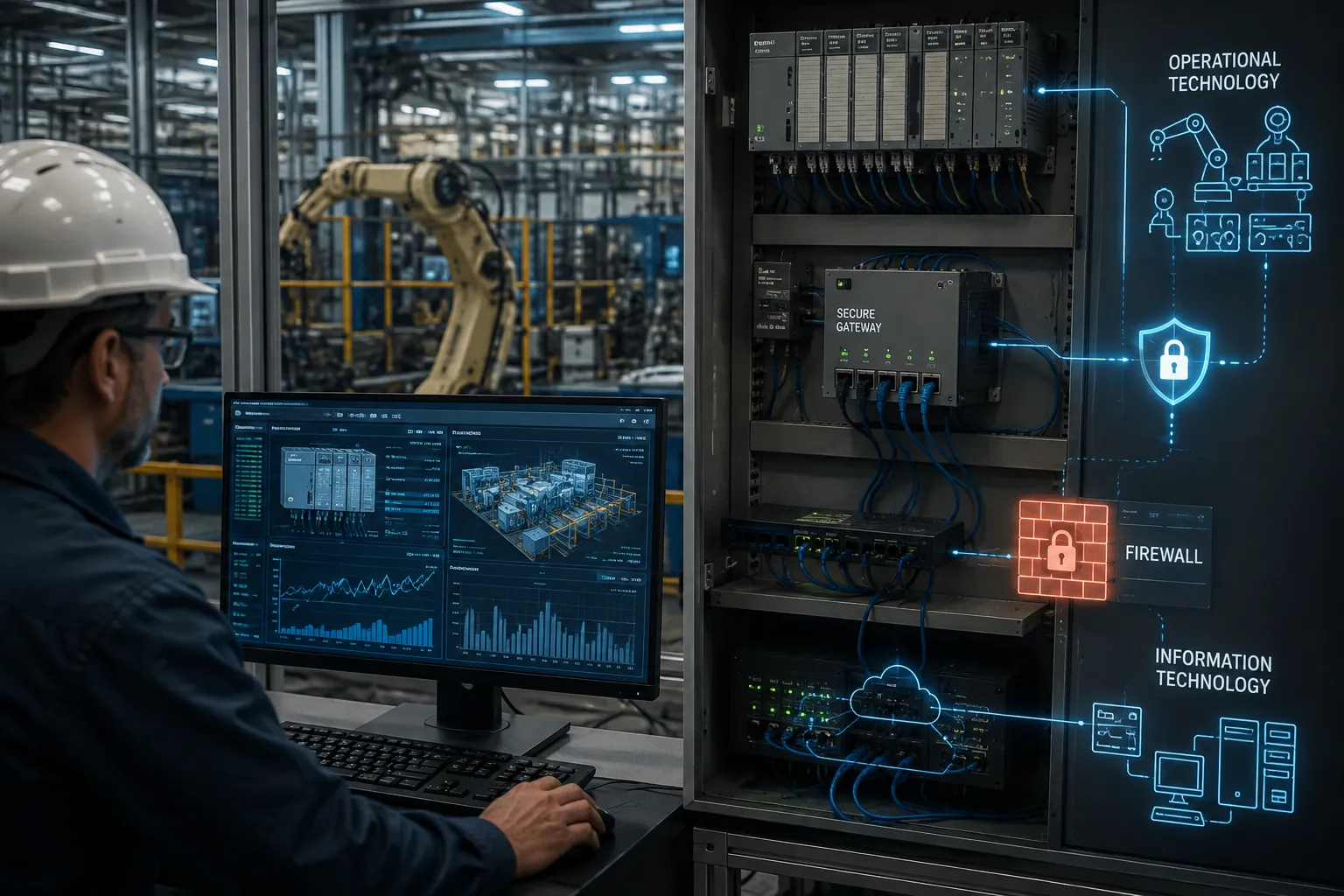
OT/IT convergence connects operational technology (PLCs, SCADA, DCS, historians) with information technology (ERP, MES, analytics, cloud) to enable real-time visibility, predictive maintenance, and digital twins. Secure convergence requires strict network segmentation (Purdue Model), industrial firewalls, protocol translation gateways, and monitoring that respects OT safety and availability requirements.
What Is OT/IT Convergence?
Operational Technology (OT) controls physical processes: programmable logic controllers (PLCs), distributed control systems (DCS), supervisory control and data acquisition (SCADA), historians. Information Technology (IT) manages business data: ERP, MES, analytics, cloud. Convergence bridges them — sending telemetry up for analytics, sending work orders down for execution.
Why Convergence Is Hard
OT priorities: safety, availability, determinism (millisecond response). IT priorities: confidentiality, integrity, patch velocity. OT runs legacy protocols (Modbus, Profibus, OPC DA) without authentication. IT uses TCP/IP, TLS, REST. Connecting them naively exposes safety-critical systems to cyber risk.
Key Challenges
Legacy Protocol Insecurity
Modbus/TCP has no encryption, no authentication. Any device on the network can read/write registers. OPC DA relies on DCOM — notoriously hard to secure. Proprietary protocols vary by vendor (Siemens S7, Rockwell CIP, Mitsubishi MC).
Patch Management Conflict
OT vendors certify specific OS/patch levels. Applying Windows updates can break HMI/SCADA software. OT assets often run Windows 7/10 LTSC, Server 2012/2016 — unpatched for years. IT patch cycles (monthly) are incompatible.
Organizational Silos
OT reports to plant manager / VP Manufacturing. IT reports to CIO. Different budgets, vocabularies, risk tolerances. OT fears IT changes causing downtime. IT fears OT as uncontrolled attack surface.
Recommended Architecture: Purdue Model
The Purdue Enterprise Reference Architecture (IEC 62443) defines hierarchical zones:
- Level 0: Physical processes (sensors, actuators, drives).
- Level 1: Basic control (PLCs, safety systems). Real-time, deterministic.
- Level 2: Area supervisory (SCADA, HMI, historians). Local visualization.
- Level 3: Operations management (MES, LIMS, batch management). Site-level.
- Level 4: Business logistics (ERP, supply chain, analytics). Enterprise.
- Level 5: Cloud / external (analytics, AI, vendor remote access).
Communication flows adjacent levels only. Level 3/4 boundary = Industrial DMZ with data diodes / firewalls.
Industrial DMZ & Data Diodes
Place historians and OPC UA aggregation servers in DMZ. IT systems pull from DMZ (unidirectional or strictly controlled bidirectional). Data diodes (hardware-enforced one-way) for highest-assurance egress from Level 2 to 3.
Protocol Translation Gateways
Deploy edge gateways (e.g., Kepware, Matrikon, Softing, Advantech) at Level 2/3 boundary. Translate Modbus, S7, CIP, OPC DA → OPC UA / MQTT / MQTT Sparkplug B. Enforce read-only for telemetry. Write commands require authenticated, authorized sessions.
Unified Monitoring with OT Context
Extend IT monitoring (Zabbix, Datadog, Splunk) with OT protocol collectors. Alert on: PLC mode changes (RUN/PROG), safety system trips, communication loss, anomalous setpoint changes. Correlate with IT logs (VPN, AD, firewall).
Implementation Roadmap
- Discover: Passive network taps (Armis, Claroty, Nozomi) to map OT assets, protocols, communications — no active scanning.
- Segment: Implement Purdue zones with industrial firewalls (Cisco ISA3000, FortiGate Rugged, Palo Alto OT). Default deny.
- Gateway: Deploy protocol translation at Level 2/3. Standardize on OPC UA / MQTT Sparkplug B.
- Monitor: Extend SIEM with OT parsers. Build OT-aware playbooks.
- Govern: Joint OT/IT security committee. Shared risk register. Coordinated patch windows.
| Aspect | Flat Network (IT-style) | Purdue Model Convergence |
|---|---|---|
| Network Topology | Single broadcast domain | Hierarchical zones (L0-L5) |
| PLC Accessibility | Direct from corporate | Via gateway in DMZ only |
| Protocol Security | None (Modbus cleartext) | OPC UA / MQTT with TLS + auth |
| Patch Management | Monthly IT cycle | Coordinated windows, vendor-certified |
| Monitoring | IT logs only | OT-aware (PLC mode, safety trips, setpoints) |
| Incident Response | IT playbooks | Joint OT/IT playbooks with safety priority |
Flat IT-style network vs. Purdue Model secure OT/IT convergence
Practical Recommendations
- Start with passive asset discovery — never scan OT networks actively.
- Enforce Purdue Model segmentation with industrial-grade firewalls. Default deny between zones.
- Standardize on OPC UA and MQTT Sparkplug B for all new OT/IT data exchange.
- Deploy hardware data diodes for highest-criticality egress (safety systems, nuclear, pharma).
- Establish joint OT/IT security governance with shared risk register and coordinated maintenance windows.